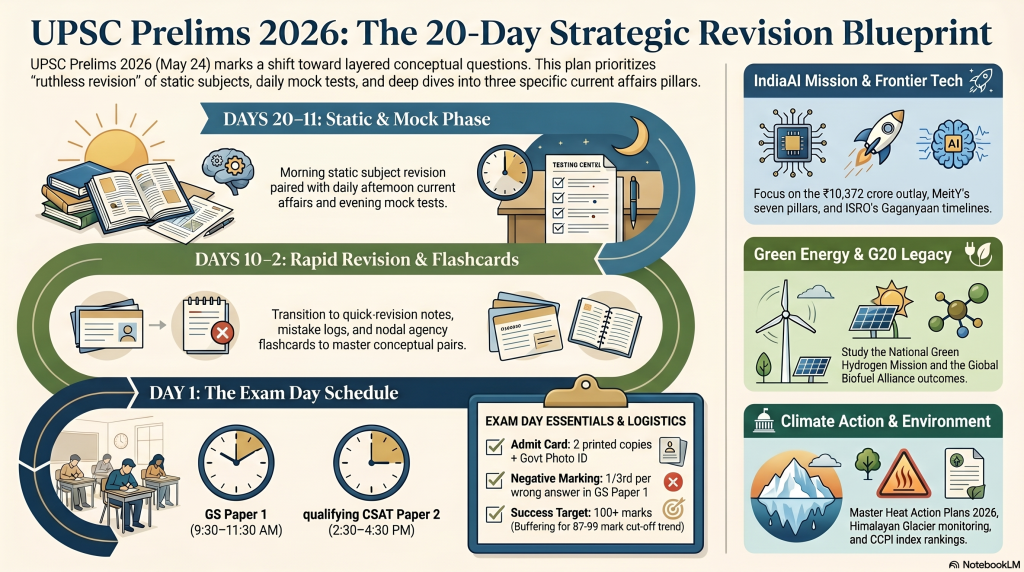
The clock is ticking. UPSC Prelims 2026 is on Sunday, May 24, 2026 — just 22 days away from today. The next three weeks are not the time to start a new textbook or chase fresh material. They are for ruthless revision, smart current-affairs consolidation, and decoding the new analytical pattern of GS Paper 1. This last-minute guide gives you a 20-day countdown calendar, the five most-asked current-affairs themes from the past 12 months, and a trend analysis of how the Commission has shifted from one-line factual recall to layered conceptual pairs.
Bookmark this page — we’ll keep it updated through May 23. For confirmed exam dates and notification, refer to upsc.gov.in and download your admit card from upsconline.nic.in. You can also find broader exam resources, syllabus, and previous-year papers on our UPSC IAS Exam guide on AglaSem Admission.
UPSC Prelims 2026 — The Final Stretch
This year, the Commission has notified roughly 933 vacancies across IAS, IPS, IFS and Group B services. The Preliminary Examination is the screening stage, with two objective papers held the same day: GS Paper 1 (counts for merit) and CSAT Paper 2 (qualifying, 33% minimum). The cut-off battle is decided in GS Paper 1 — and that is where this revision plan focuses.
| Key Detail | Information |
|---|---|
| Exam Date | Sunday, May 24, 2026 |
| GS Paper 1 Timing | 9:30 AM – 11:30 AM |
| CSAT Paper 2 Timing | 2:30 PM – 4:30 PM |
| Mode | Pen-and-paper, OMR |
| Negative Marking | 1/3rd per wrong answer |
| Vacancies | ~933 (CSE + IFoS combined) |
| Admit Card | Released ~3 weeks before exam at upsc.gov.in |
20-Day Countdown Calendar for UPSC Prelims 2026
The principle behind this calendar is simple: nothing new, only revision. Mornings for high-yield static subjects, afternoons for current affairs and PYQs, evenings for one full-length mock with analysis. Sundays are reserved for full mocks and weak-area drills.
| Day | Date (2026) | Morning Focus | Afternoon Focus | Evening |
|---|---|---|---|---|
| D-20 | May 5 (Tue) | Polity — Constitution + FRs/DPSP | CA: Government Schemes (Jan–Apr 2026) | Mock 1 + analysis |
| D-19 | May 6 (Wed) | Polity — Parliament + Judiciary | Theme: India’s AI Mission | PYQ 2024 GS-1 |
| D-18 | May 7 (Thu) | Modern History — 1857–1947 timeline | Theme: Green Hydrogen + Climate | Mock 2 + analysis |
| D-17 | May 8 (Fri) | Art & Culture — Architecture, Dance | Economy — Budget 2026 highlights | PYQ 2023 GS-1 |
| D-16 | May 9 (Sat) | Geography — Indian Physical + Climate | Theme: G20 outcomes & foreign policy | Mock 3 + analysis |
| D-15 | May 10 (Sun) | Full-length Mock 4 (10–12) | Detailed analysis (2–6 PM) | Weak-topic notes |
| D-14 | May 11 (Mon) | Environment — Acts, Conventions | Theme: Space & Defence Tech | PYQ 2022 GS-1 |
| D-13 | May 12 (Tue) | Polity — Local Govt, Federalism | CA: International Relations Q1 2026 | Mock 5 + analysis |
| D-12 | May 13 (Wed) | Economy — Banking, RBI, Inflation | Theme: Indices & Reports of 2025–26 | PYQ 2021 GS-1 |
| D-11 | May 14 (Thu) | Modern History — Post-Independence | CA Compilation: Mar–Apr 2026 | Mock 6 + analysis |
| D-10 | May 15 (Fri) | Geography — World + Maps | Environment — Species, Tiger Reserves | CSAT mock |
| D-9 | May 16 (Sat) | Polity — Quick revision (notes) | Economy — Quick revision | Mock 7 + analysis |
| D-8 | May 17 (Sun) | Full-length Mock 8 | Analysis + 2nd revision of CA | Weak topics |
| D-7 | May 18 (Mon) | Art & Culture revision | Modern History revision | Mock 9 |
| D-6 | May 19 (Tue) | Geography quick revision | Environment quick revision | CSAT mock |
| D-5 | May 20 (Wed) | CA: full year flashcards | Schemes + Indices flashcards | Mock 10 |
| D-4 | May 21 (Thu) | NCERT skim (Class 11–12 GS) | One-pager notes revision | Light CSAT |
| D-3 | May 22 (Fri) | Mistake-log review | Mock 11 (light) | Sleep early |
| D-2 | May 23 (Sat) | Final revision — only your own notes | Admit card, ID, kit packing | Sleep by 10 PM |
| D-1 | May 24 (Sun) | EXAM DAY | EXAM DAY | — |
5 Must-Read Current Affairs Themes for UPSC Prelims 2026
Looking at the trend of the last three Prelims papers, roughly 25–30% of GS Paper 1 questions are now drawn from current affairs of the preceding 12 months. These five themes are non-negotiable for UPSC Prelims 2026.
1. India’s AI Mission and the National AI Research Grid
The IndiaAI Mission (₹10,372 crore outlay), the National AI Research Grid unveiled in February 2026, the AI-generated political-content guidelines from the Election Commission, and India’s stand at the Global AI Summit — expect a question linking institutions, fund allocation, and ethics. Memorise: nodal ministry (MeitY), the seven IndiaAI pillars, and the AI Compute capacity target.
2. G20 Outcomes — New Delhi Declaration Legacy & Beyond
The follow-through from India’s G20 Presidency is a recurring favourite: African Union induction, Global Biofuel Alliance, IMEC corridor, Digital Public Infrastructure stack, and the G20 Hydrogen Working Group on interoperability of standards. Cross-link this with foreign policy events post-2024 and India’s pitch for permanent UNSC membership.
3. National Green Hydrogen Mission & Clean Energy Push
NGHM (₹19,744 crore outlay, 5 MMT/year by 2030), the Green Hydrogen Certification Scheme India (April 2025, BEE as nodal authority), three coastal hubs at Kandla–Paradip–Tuticorin (October 2025), and the world’s highest-altitude H₂ mobility project at NTPC Leh. Pair this with Net Zero 2070, Mission Innovation, and the Sembcorp–India MoU.
4. Climate Action: Heat Action Plan, Glacier Monitoring & SDGs
National Heat Action Plan 2026 (Feb 7), expanded Himalayan Glacier Monitoring Mission, India’s revised NDCs, and the COP outcomes. Be ready to identify which conventions India is signatory to, the difference between RAMSAR and CITES sites, and key indices like Climate Change Performance Index 2026.
5. Space, Defence & Frontier Tech
Gaganyaan crewed mission timelines, EOS-09 launch (Feb 6, 2026), Chandrayaan follow-on plans, ISRO docking experiment (Jan 24, 2026), India’s first hydrogen-powered train trial on the Jind–Sonipat route, and quantum/semiconductor mission updates. Add nuclear (SMRs, ITER) and biotech (CAR-T, BioE3 policy) for full coverage.
UPSC Prelims 2026 Trend Analysis: From Direct Facts to Conceptual Pairs
The biggest shift in recent UPSC Prelims papers is the move away from “Which is correct?” type one-line factual questions, toward layered “How many of the above pairs are correctly matched?” or “How many of the above statements are correct?” formats. In 2024 and 2025, over 35% of GS Paper 1 questions used these multi-statement and pair-matching frames — each requiring the candidate to be right on every sub-point.
📊 The New Question Anatomy
Typical UPSC Prelims 2026 question stem now reads:
“Consider the following pairs: (1) Mission Karmayogi — DoPT (2) AIM 2.0 — NITI Aayog (3) Bharat 6G Vision — DoT. How many of the above pairs are correctly matched?”
Options: (a) Only one (b) Only two (c) All three (d) None. The candidate has no room to guess from elimination — every pair must be verified independently.
5 Strategy Tweaks for the New Pattern in UPSC Prelims 2026
- Make pair-matching cards. Convert every scheme, report, mission, and committee into a flashcard linking it to its nodal ministry/agency. This is where ~70% of pair-matching questions get decided.
- Default to elimination. If you can confidently eliminate even one wrong statement/pair, the answer choice narrows from four to two. Resist the urge to attempt unless you’ve eliminated at least one option.
- Master the “Only one” trap. UPSC frequently puts “Only one” as the answer when two of three statements look correct. Be paranoid about second-guessing well-known facts — they’re usually placed as decoys.
- Read the negation. “Which of the following is not correctly matched?” flips the entire logic. Underline the negation as you read.
- Bank on PYQs. The Commission consistently recycles concepts (not exact questions). Solve the last 10 years’ GS-1 papers thematically — you’ll see the same constitutional articles, environmental conventions, and economic indices reappear in new framings.
Last 7-Day Sprint Plan for UPSC Prelims 2026
- Day 7 to Day 5: Three full-length mocks. After each, spend twice the test duration on analysis — a 2-hour mock deserves 4 hours of dissection.
- Day 4 to Day 3: Only your own notes. No new source. No YouTube videos. Trust the work you’ve already done.
- Day 2: Light revision of Polity, Environment, and the 5 themes above. Pack your kit — admit card (2 copies), ID proof, blue-black ballpoint pens, transparent water bottle.
- Day 1 (Exam Day): Reach the centre 90 minutes early. Don’t open a textbook. Trust yourself.
Exam-Day Checklist for UPSC Prelims 2026
- UPSC Prelims 2026 admit card (printed, two copies)
- Original government photo ID (Aadhaar / Voter ID / Passport / Driving Licence)
- Two passport-size photographs
- Blue or black ballpoint pen (two)
- Transparent water bottle
- Wristwatch (analog, no smart features)
- No mobile phone, calculator, smart device, or unauthorised material
Frequently Asked Questions on UPSC Prelims 2026
When is UPSC Prelims 2026?
UPSC Prelims 2026 is on Sunday, May 24, 2026. GS Paper 1 is held from 9:30 AM to 11:30 AM and CSAT Paper 2 from 2:30 PM to 4:30 PM, both in offline OMR mode.
When can I download the UPSC Prelims 2026 admit card?
The Commission typically releases the e-admit card three weeks before the exam at upsc.gov.in. Check your One-Time Registration (OTR) login on upsconline.nic.in regularly.
How many questions are asked in GS Paper 1 of UPSC Prelims 2026?
GS Paper 1 has 100 multiple-choice questions for 200 marks. Each correct answer fetches 2 marks; each wrong answer attracts a 1/3rd negative marking (−0.66). Unattempted questions carry no penalty.
How important is current affairs for UPSC Prelims 2026?
Approximately 25–30% of GS Paper 1 in recent years has been current affairs-driven, with another 15–20% indirectly linked through schemes, reports, and indices. Strong current affairs preparation can be the difference between clearing and missing the cut-off.
What is the cut-off trend for UPSC Prelims?
UPSC Prelims General-category cut-offs in recent years have ranged between 87 and 99 marks (out of 200). Aim for 100+ in your mocks to comfortably clear UPSC Prelims 2026 — buffer is critical given the negative-marking risk.
Useful Official Links
- UPSC Official Website: upsc.gov.in
- UPSC Online Application Portal: upsconline.nic.in
- PIB Press Releases (for current affairs): pib.gov.in
- PRS India (for bills and policy notes): prsindia.org
Keep this UPSC Prelims 2026 guide handy through the final 22 days. Trust your prep, follow the calendar, and remember — the Mains is just three months later. Stay disciplined. May 24 will reward those who revised.